
Newsday’s Faces of Long Island: Interview with Dale Bratter
Stamford Advocate: Op-Ed by Dale Bratter
For Talia, teach others about HIV and women. ‘Talia was so brave
and honest about her illness’
By Dale Napolin Bratter
March 10 is National Women and Girls HIV Awareness Day. On March 10, 1996, when I was five months into my new job as a social worker for women and children with HIV and AIDS at the Children’s Diagnostic & Treatment Center (CDTC) in Fort Lauderdale, Fla., this was just another challenging workday. In 1996 there was little public acknowledgement of anything having to do with women or girls being impacted by HIV/AIDS.
If my co-workers and I were aware of anything particularly meaningful on that day, it was that the numbers of infected women and children in major cities throughout the United States were skyrocketing; and all of those people desperately needed the medical and social services our nonprofit agency could provide. To help meet this escalating situation, I was given a small caseload within 10 days of being hired. By 2000, I was caring for 50 families, the majority having multiple infected members in them.
I believe it’s fair to say that when one thinks about the first two decades of the AIDS epidemic (1981 to 2001), only men come to mind. Women and children did not have media attention, celebrities speaking out on their behalf, or any powerful organizations such as the Gay Men’s Health Crisis or ACT Up to fight for them.
There is a long, bleak history of women being excluded from major AIDS research studies, drug trials, access to early diagnostic testing, as well as access to a potentially life-extending medication for the disease (AZT).
Women and children knew it was dangerous to reveal that they had HIV or AIDS. Rarely did their friends or even relatives know what they were going through. None of the recurring illnesses, frequent clinic appointments and hospitalizations, weight loss, and children’s absences from school could be explained truthfully. It’s not that these women were in denial; they simply could not share what was happening to them because of the stigma and overwhelming fear of AIDS at this time in the history of the epidemic.
Regarding this apparent self-preservation mechanism, let me share with you the story of one of my young female clients who, in spite of what I’ve just implied, broke the mold about publicly sharing her diagnosis.
I was Talia’s social worker from the time she was 9 years old until age 13. As a child with HIV, she was quite unique in surprising ways — she had no qualms about sharing her diagnosis and was unafraid of the inevitable negative responses. Talia told family members, friends, and even classmates about her HIV status.
After Talia’s mother died of AIDS, she and her siblings went to live with their mom’s sister Joanne. The day Joanne called and told me her niece was revealing her diagnosis to people, I immediately scheduled a home visit. I wanted to understand how she had reached this decision about something so many people were, understandably, not willing to reveal.
“I was born with this disease,” she stated very matter-of-factly, “and I’m not ashamed.”
It was clear to me that Talia had thought through what had happened to her at birth and had made peace with it. She felt it was her responsibility to teach people about HIV and AIDS, to help others from becoming infected, and to give them emotional support if they were infected already. By disclosing her own diagnosis and wanting to help keep others safe, Talia proved herself to be brave and mature beyond her years.
In 2004, I was in a new position and no longer worked directly with clients. One day, Talia’s Aunt Joanne called to advise me Talia had died. She was only 17. Though she had not been my client for four years, Joanne was aware of the trust that had developed between us, and asked me to deliver a eulogy at the funeral, adding that everyone coming knew Talia had died of AIDS. Because she had alerted me to this fact, I was able to craft a different kind of eulogy from others I had written in the past. I didn’t have to keep “the secret.” I could talk freely about Talia’s fearlessness and truth telling. Had she lived longer, she would have undoubtedly grown into a powerful voice for education about the disease and acceptance of people with HIV/AIDS.
Standing behind the pulpit at the funeral, I looked out at the large crowd of people who had come to the church for Talia’s homegoing. Sensing that this might well be the last time I delivered such a eulogy, I wanted to do right by this brave young woman and her loving family. I wanted to include them because of their unselfish acceptance of this terminally ill child and her siblings into their lives.
As I read my eulogy, the congregation vocalized its approval of Talia’s actions and strength. The smiling faces of her relatives reflected their pride in her character.
Because I am a saver of things, it was not difficult to find that eulogy written 19 years earlier. Here in part, is some of what I said that day remembering and honoring Talia — her precocious courage and her too early passing.
“Talia was part of a family that had experienced a tremendous amount of loss and grief. In spite of this, they never stopped taking care of each other. They cared for Talia’s mother until her death, and then they continued to care for Talia until her passing.
“Talia’s Aunt Joanne made a deathbed promise to her sister that she would raise Talia and her siblings as best she could. She kept that promise. When Talia’s older sister, Teresha, became a teenager, she, like the grownups, took on some of the responsibility for helping with Talia.
“Last night at the viewing in the funeral home, I told Teresha that she had done a beautiful job of caring for Talia. Teresha’s eyes filled with tears as she answered me, her voice heavy with emotion.
“‘Oh, but I wasn’t finished taking care of her. I had so much more to give.’
“When I sat down to write this eulogy, I began to wonder where this family’s wellspring of strength came from. How was it that Talia was so brave and honest about her illness at a time when few others were? How was it that Teresha, just a teenager at the time, so selflessly shared in the caregiving responsibilities for her sister? Where did Talia’s passion to teach others about HIV and AIDS come from?
“I believe that until there’s a cure for AIDS, it’s up to all of us to reach out, offer support, and teach others for Talia, so that no one — child or adult — ever feels alone while battling this stigmatizing and terrifying disease. In this way, we will honor her short but beautiful life.”
Though I have retired from my years of work with women and children with HIV/AIDS, my clients’ voices, which were not heard during the early years of that epidemic, still resonate deeply with me. Their stories are missing chapters in the history of the AIDS epidemic in our country.
Today, the world is very different for women and children who are thriving while being HIV positive. Thanks to research studies specifically focused on women and children with HIV, advances in education, prevention, and access to highly effective medications, and the availability of more specialized health care providers, HIV is now viewed as a chronic disease like many others, and no longer a terminal one.

Greenwich Time: Op-Ed by Dale Bratter
View changes with finger on trigger
By Dale Bratter
I have three grandsons, all of whom play sports. My husband and I don’t go to all their games, but the game on this particular Sunday last March was very important because our 11-year-old grandson, Aidan, was competing in the league championship. I was watching with more focus than usual. In the spirit of honesty, I will admit that when Aidan or his brothers are on the bench and not playing, my focus will sometimes wander. Where it had wandered to this time I can’t recall, but when my daughter leaned in close to me and whispered, “Mom, do you see who they’re playing against?” I snapped out of my reverie. I looked at her blankly. “It’s Newtown,” she said.
I immediately locked my gaze onto the back of a single opponent’s green-and-white jersey. The boy was racing down the court, dribbling the ball skillfully toward the basket. And there on his back was the name that carried so much unbearable weight for our state, as well as our nation. Newtown. I felt a crippling weight on my chest as memories of Dec. 14, 2012 flooded back with a tsunami of images and emotions. I made a quick calculation and realized the boys on the opposing team were the right age to be the classmates, siblings, cousins or friends of some of the children who were murdered. Oh, what they all witnessed or experienced that day. Tears burned into the backs of my eyes.
Then the boy made the basket. The people filling the bleachers on the other side of the gym erupted with cheers and whistles and stomped their feet in recognition of the boy and the two points scored. For a moment, the room vibrated with their happiness. Then I realized who these happy people were. They were the parents, grandparents, siblings or friends of the children who were murdered that day by a severely mentally ill, socially alienated young man carrying a semi-automatic rifle and two handguns. All of the people cheering, children and adults alike, were finding ways to put their grief aside and resurrect their lives in spite of what our country’s horrendously lax gun laws had brought upon their families and their community.
All of the above brings me to my own past relationship to guns. As a child growing up in the 1950s, I played with guns — cap guns and toy rifles. How could you play cowboys and Indians and cops and robbers without guns? My parents didn’t hesitate when I asked them to buy me a holster for my gun. It was no different when I begged for chaps for my blue jeans, a sheriff’s badge, or a Dick Tracy watch. The good guy had to beat the bad guy, right? And one way of doing this was by shooting him.
I lost my affection for guns at about age 10, but have maintained an interest in law enforcement. When I was 27, foolishly I’ll admit, I even made a citizen’s arrest of a drug-addicted robber. It was because of the Sandy Hook tragedy, however, and my growing awareness of the enormous political clout of the National Rifle Association that I began to participate actively in anti-gun violence causes.
In addition to the NRA’s political rhetoric about guns in our society, police use of weapons was also of compelling concern to me. News reports of officers using firearms in hard-to-explain ways resulting in the killings of so many African-American men, was straining my childhood notion of the police as always being the good guys.
Last month I learned about the Greenwich Police Citizens’ Policy Academy (GPCPA), an intensive 11-week course designed to educate the community about how police are trained to professionally carry out all aspects of their jobs. The instructors are highly experienced Greenwich police officers. I saw this course as my opportunity to receive a clearer understanding of how law enforcement works.
In addition to 265 hours of class time, there is also an off-site re-enactment of a hostage situation; an opportunity to accompany officers on marine and patrol car ride-alongs; and a class held at the police firing range. At that setting, students receive a summary but explicit lesson on gun safety, firing range etiquette, and gun grip followed by practice shooting with live ammo at a target. The next section of the class would involve an exercise requiring split-second judgment about whether to use lethal force.
I applied and my application was accepted. This is how on the evening of May 1, I found myself, an anti-gun activist, in the unlikely setting of a shooting range, holding a 9mm Glock pistol with a single live bullet in the chamber. I was ready to respond to a video reenactment of a “shots fired” 911 call.
The two students before me responded to their video scenarios of active shooters at a car dealership and an auto body shop. Where was my storyline going to take place? It was in a school, of all places. A teenage boy was arguing with a teacher in the front hall. Shots rang out. I tensed up immediately. Where did the shots come from? I felt my heartbeat quicken. I gripped the handle of my gun tightly, at the same time trying desperately to prevent my trigger finger from becoming too tense. Suddenly a set of double doors swung open and two students raced through them, seemingly right at me. I didn’t think. I reacted. BOOM! I shot and “killed” a young, unarmed girl. Then, two more students charged through the doors, both of them unarmed. Another teenager raced out and on his heels was a boy with a gun pointed at him. I was helpless to do anything because I had already used my one bullet to “kill” an innocent student. The shooter fired and “killed” the boy running in front of him. End of scenario.
It was also the end of my bewilderment. I now understand how police officers can make mistakes and kill someone in what they assume to be a life-or-death situation. Having experienced my anxiety about when to fire a weapon, even though it was in a simulated situation, I now have an unmistakable sense of what can be going on in a “good guy’s” head when he or she believes their or someone else’s life is at stake. The decision to fire or not to fire has to be made in a second. For me, whether guns are in the hands of the wrong people or the right people, they will still always be dangerous.
Finally, my grandson’s basketball game against Newtown and the anguished memories it triggered in me now have a larger meaning beyond that athletic competition. My studies at the GPCPA have armed me with the knowledge that owning and using a firearm involves split-second decision-making. Such decisions require full use of human faculties. Newtown’s horrific tragedy was caused by an individual whose mental illness impaired his cognitive and decision-making processes. Such individuals must never have access to firearms. No more Newtowns!
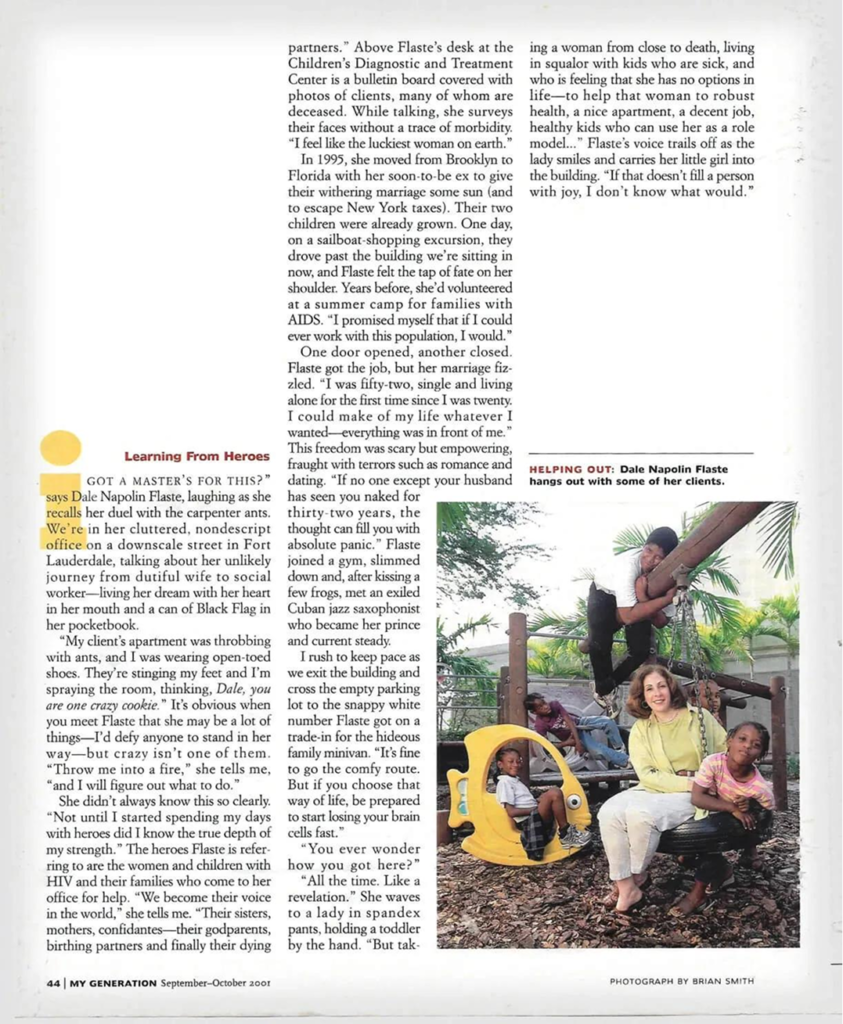
AARP, MY GENERATION (Magazine): Interview with Dale (Flaste) Bratter
“Surprised by Joy,” Dale in conversation with Mark Matousek (issue Sept–Oct 2001)